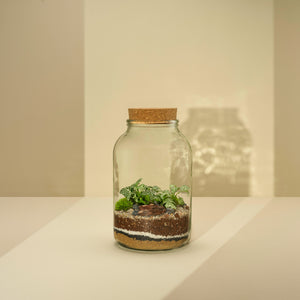
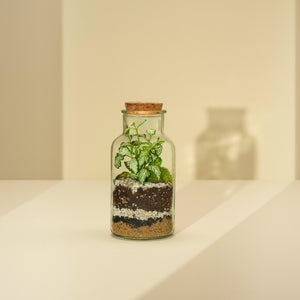
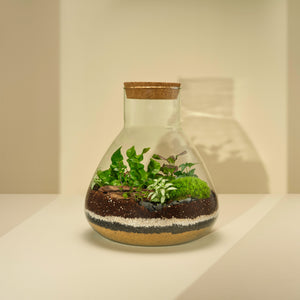
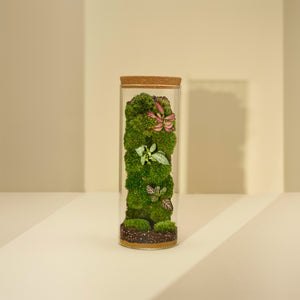

Terrariums are sold as low-maintenance.
What they’re not sold as? Fail-proof.
If you’re here, something feels off. The glass is foggy. A plant looks sad. There’s mold where there definitely shouldn’t be mold. And now you’re wondering if you somehow managed to kill a plant ecosystem that’s supposed to take care of itself.
You’re not bad at plants.
You’re just missing a few signals your terrarium is trying to send you.
Let’s decode them.

1. Too Much Condensation in Your Terrarium (And What It Really Means)
Common searches:
-
“Why is my terrarium always foggy?”
-
“Too much condensation in closed terrarium”
-
“Terrarium water droplets on glass”
The problem
A little condensation is normal. Constant fogging or dripping water is not.
If you can’t see clearly through the glass most of the day, your terrarium is holding too much moisture.
Why it happens
-
Overwatering (the most common cause)
-
Terrarium placed in direct sunlight
-
Poor airflow inside the container
-
Warm room + sealed glass = moisture trap
How to fix it
-
Open the terrarium for 6–24 hours to release excess humidity
-
Move it to bright, indirect light (never full sun)
-
If condensation returns daily, remove a small amount of water from the substrate using a paper towel or pipette
Rule of thumb:
Condensation in the morning = OK
Condensation all day = problem


2. Mold in a Terrarium: White, Fuzzy, or Spider-Web-Like Growth
Common searches:
-
“White mold in terrarium soil”
-
“Is mold bad in a terrarium?”
-
“How to remove mold from terrarium”
The problem
Mold looks scary—but it’s not always a death sentence.
Small patches of white mold usually mean your terrarium is too wet and too stagnant.
Why it happens
-
Excess moisture
-
Decomposing organic matter
-
No airflow
-
New terrariums still stabilizing
How to fix it
-
Remove visible mold with tweezers or a spoon
-
Open the terrarium for several hours a day for a few days
-
Reduce watering going forward
-
Optional but effective: add springtails (they eat mold)
If mold keeps coming back aggressively, that’s your sign the ecosystem is unbalanced—not cursed.

3. Plant Rot in Terrariums (The Silent Killer)
Common searches:
-
“Why is my terrarium plant rotting?”
-
“Soft black stems terrarium”
-
“Root rot in closed terrarium”
The problem
Plant rot usually shows up as:
-
Mushy stems
-
Blackened roots
-
Plants collapsing from the base
At this point, less water will not save the plant.
Why it happens
-
Constantly soaked soil
-
No drainage layer
-
Water pooling at the bottom
-
Overwatering “just in case”
How to fix it
-
Remove the rotting plant immediately (it spreads)
-
Check if the remaining soil smells bad—if yes, remove and replace it
-
Let the terrarium air out for a full day
-
Going forward: water far less than you think you need
Closed terrariums thrive on neglect, not care.

4. Yellowing Leaves in Terrariums (Not Always What You Think)
Common searches:
-
“Terrarium leaves turning yellow”
-
“Yellow leaves closed terrarium”
-
“Is my terrarium getting too much light?”
The problem
Yellow leaves are confusing because they can mean too much water or too little light.
The real causes
-
Overwatering (most common)
-
Sudden light changes
-
Old leaves naturally dying
-
Plants that don’t belong in closed terrariums
How to fix it
-
Remove yellow leaves (they won’t recover)
-
Evaluate placement: bright, indirect light only
-
Reduce watering frequency
-
Make sure you’re using humidity-loving plants (ferns, moss, fittonia)
If new leaves are healthy and green, you’re fine.
If everything is yellowing, something systemic is off.

5. When a Terrarium Just “Doesn’t Look Right”
Sometimes nothing is obviously wrong—but it feels wrong.
The glass is dull. Growth has stopped. Everything looks tired.
That usually means:
-
The terrarium needs air for a day
-
It’s in a dead light zone
-
It’s been over-handled
Reset move (safe for almost all terrariums)
-
Open for 12–24 hours
-
Move to indirect daylight
-
Don’t water
-
Observe for a week
Terrariums fix themselves when you stop interfering.
How to Prevent Most Terrarium Problems (Read This Twice)
-
Water once, then wait weeks
-
Condensation is feedback—learn to read it
-
Never place in direct sunlight
-
Less care = better ecosystem
-
When in doubt, do nothing
Most terrarium issues aren’t from neglect.
They’re from love applied too often.

Final thoughts
A terrarium isn’t a houseplant.
It’s a closed system, and every small action echoes longer than you expect.
If you listen instead of reacting, it will tell you exactly what it needs.
And most of the time?
It needs you to step back.